

The Cloudflare outage taught us that the internet’s backbone is fragile, over‑centralized, and highly dependent on single points of failure. It highlighted the need for redundancy, better change management, and diversified infrastructure strategies.
🔑 Key Lessons from the Cloudflare Outage
- Single points of failure are dangerous Cloudflare supports ~20% of global web traffic. When it went down, platforms like X (Twitter), ChatGPT, Spotify, Canva, Shopify, and even government sites were disrupted simultaneously. This shows how much of the internet depends on one provider.
- Root cause: internal misconfiguration, not cyberattack The outage wasn’t caused by hackers but by a faulty database permission update. This change created duplicate entries in a bot management file, which propagated globally and triggered widespread 5xx errors. It’s a reminder that routine updates can have catastrophic ripple effects if not carefully tested.
- Resilience requires diversification Governments and organizations stressed the importance of using multiple cloud providers to mitigate risks. Relying on a single vendor—even one as robust as Cloudflare—can expose businesses and public services to massive downtime.
- Monitoring and transparency matter Outage trackers like Downdetector showed spikes in complaints within minutes. Cloudflare’s CEO quickly acknowledged the issue and published a postmortem. Transparent communication helps maintain trust during crises.
- Centralized infrastructure is fragile The incident reinforced that modern internet architecture is brittle. A single misstep in a centralized system can stall digital life across continents.
🌍 Broader Implications
- Business continuity planning: Companies must prepare for vendor outages with failover systems, cached content, or alternative CDNs.
- Public sector caution: Governments and healthcare systems need multi‑provider strategies to avoid service paralysis.
- Cultural reminder: The outage showed how deeply daily life depends on invisible infrastructure—when it breaks, everything from social media to commerce to public services grinds to a halt.
⚡ Takeaway #1
The Cloudflare outage wasn’t just a technical glitch—it was a wake‑up call. Resilient internet design means decentralization, redundancy, and rigorous change management. Without these, even a routine update can bring the digital world to a standstill.
Businesses learned that resilience requires diversification, redundancy, and proactive risk management. The Cloudflare outage showed that relying on a single provider—even one as robust as Cloudflare—can paralyze operations globally.
🛠 Practical Steps Businesses Can Take
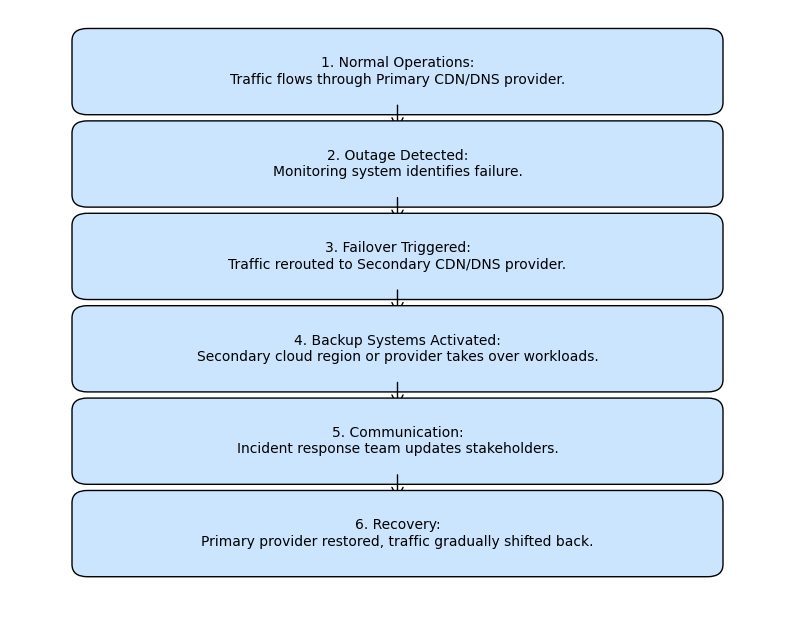
- Adopt a multi‑CDN strategy Don’t let one provider be your single point of failure. Using multiple CDNs ensures traffic can reroute if one collapses.
- Implement failover DNS and backup security layers Secondary DNS providers and layered security systems keep websites accessible even when the primary vendor fails.
- Design for failure, not perfection Outages aren’t rare—they’re inevitable. Systems should be architected with the assumption that things will go wrong, so fallback mechanisms are ready.
- Diversify cloud dependencies Many businesses rely heavily on one cloud or SaaS provider. Spreading workloads across multiple vendors reduces systemic risk.
- Strengthen monitoring and incident response Real‑time monitoring, automated alerts, and clear escalation paths help detect and contain issues faster.
- Test disaster recovery regularly Simulate outages to ensure teams know how to respond. A plan that isn’t tested is just theory.
- Consider digital sovereignty Governments and large enterprises should invest in domestic or independent infrastructure to avoid exposure to foreign provider failures.
🌍 Why This Matters
- SMBs: The outage revealed that small businesses are only as resilient as the weakest link in their tech stack.
- Enterprises: Even with millions invested in security, hyper‑centralization can turn protective systems into vulnerabilities.
- Governments: National economies can be disrupted by foreign infrastructure failures, making sovereignty and local alternatives critical.
⚡ Takeaway #2
The Cloudflare outage wasn’t just a glitch—it was a stress test of global digital dependence. Businesses that build redundancy, diversify providers, and prepare for failure will weather the next disruption far better than those who assume stability is guaranteed.
✅ Business Resilience Checklist (Post‑Cloudflare Outage)
1. Infrastructure Redundancy
- Use multi‑CDN providers to avoid a single point of failure.
- Implement secondary DNS services for automatic failover.
- Ensure critical apps can run in multiple cloud regions/providers.
2. Change Management
- Enforce strict approval workflows for configuration changes.
- Test updates in staging environments before global rollout.
- Maintain rollback procedures for rapid recovery.
3. Monitoring & Alerts
- Deploy real‑time monitoring for traffic, latency, and error rates.
- Set up automated alerts for anomalies.
- Use third‑party outage trackers (e.g., Downdetector) for external validation.
4. Disaster Recovery Planning
- Document failover procedures and rehearse them regularly.
- Run chaos engineering drills (simulate outages to test resilience).
- Keep offline backups of critical data and configs.
5. Vendor Diversification
- Avoid over‑reliance on one SaaS or cloud provider.
- Spread workloads across multiple vendors where possible.
- Evaluate local/regional providers for sovereignty and compliance.
6. Communication Strategy
- Prepare incident response templates for customers and stakeholders.
- Be transparent—share root cause analyses quickly.
- Train staff on crisis communication protocols.
7. Security & Compliance
- Layer security tools (WAF, bot management, DDoS protection) across providers.
- Ensure compliance with industry regulations even during failover.
- Audit vendor contracts for uptime guarantees and SLAs.
⚡ Quick Audit Questions
- Do we have at least two CDNs/DNS providers?
- Can we reroute traffic within minutes of an outage?
- Have we tested disaster recovery in the last 6 months?
- Is our incident communication plan ready and practiced?
This checklist transforms the outage lessons into actionable safeguards. Businesses that adopt these measures will be far less vulnerable when the next big disruption hits.
Remember, you are not alone. Mneumonix can assist you through this process, simply get in touch to find out how we can help.