

- Remote Working and Outsourcing: The Future for Business (3/29/2026)
Remote working and outsourcing have moved from niche strategies to central pillars of modern business. As organisations across the UK and beyond rethink how work is delivered, these two models are proving essential for building agile, cost‑effective, and globally competitive operations.
A New Era of Work
The rise of digital tools, cloud platforms, and global connectivity has made it easier than ever for companies to operate without borders. What began as a response to global disruption has evolved into a long‑term shift in how businesses structure their teams and workflows.
Remote working empowers employees to contribute from anywhere, while outsourcing allows companies to tap into specialised expertise across the world. Together, they form a powerful combination.
Why Remote Working and Outsourcing Benefit Businesses
1. Significant Cost Savings
Businesses can reduce:
- Office space and overheads
- Recruitment and training costs
- Expenses tied to full‑time staffing
Outsourcing specific functions—such as IT support, customer service, or accounting—lets companies pay only for what they need.
2. Access to Global Talent and Expertise
Remote working expands the talent pool geographically.
Outsourcing expands it strategically.Companies can:
- Hire top professionals regardless of location
- Access niche skills not available in‑house
- Scale teams quickly without long-term commitments
3. Increased Productivity and Efficiency
Remote workers often report:
- Fewer distractions
- Better work–life balance
- Higher job satisfaction
Outsourcing partners, meanwhile, bring established processes and specialised knowledge, boosting operational efficiency.
4. Greater Business Flexibility
Combining remote work with outsourcing allows companies to:
- Adapt quickly to market changes
- Scale up or down with minimal disruption
- Focus internal teams on core business priorities
Challenges to Navigate
While the benefits are substantial, businesses must address:
Communication & Collaboration
- Maintaining cohesion across distributed teams
- Ensuring outsourced partners align with company values
Cybersecurity
- Protecting data across multiple locations and vendors
- Implementing strong access controls and training
Quality Control
- Monitoring outsourced work effectively
- Maintaining consistent service standards
Forward‑thinking organisations are investing in digital collaboration tools, clear governance frameworks, and robust cybersecurity measures to overcome these challenges.
The Future: A Blended Workforce
The future of business is neither fully remote nor entirely outsourced—it’s a strategic blend.
Why This Hybrid Model Works
- It supports flexibility and resilience
- It enables rapid scaling
- It reduces costs while improving access to talent
- It allows businesses to stay competitive in a global market
Companies that embrace this blended approach are already seeing gains in innovation, efficiency, and employee satisfaction.
Conclusion
Remote working and outsourcing are no longer optional—they’re essential components of a modern business strategy. Organisations that adopt these models thoughtfully will be better equipped to thrive in an increasingly digital, interconnected world.
- The Benefits of Outsourcing IT Support for Small Businesses (2/9/2026)
For many small businesses, managing IT in‑house can feel like an uphill battle — costly, time‑consuming, and often outside the team’s core expertise. Outsourcing IT support has become one of the most effective ways for smaller organisations to stay secure, productive, and competitive without stretching their resources.
Remote support, in particular, has transformed what’s possible. It gives businesses instant access to expert help without waiting for an engineer to arrive on‑site. And when delivered by a specialist provider like Mneumonix IT Consultants, it becomes a value‑for‑money solution that blends efficiency, reliability, and professional expertise.
Cost‑Effective Access to Expertise

Hiring, training, and retaining an internal IT team is expensive — especially for small businesses that don’t need full‑time support. Outsourcing eliminates these overheads entirely. Instead of paying salaries, benefits, and ongoing training costs, businesses pay only for the support they need. This makes professional IT assistance far more affordable and predictable. Mneumonix IT Consultants provide enterprise‑level expertise at small‑business‑friendly pricing, ensuring clients get maximum value without compromising on quality.
Greater Efficiency and Faster Problem Resolution
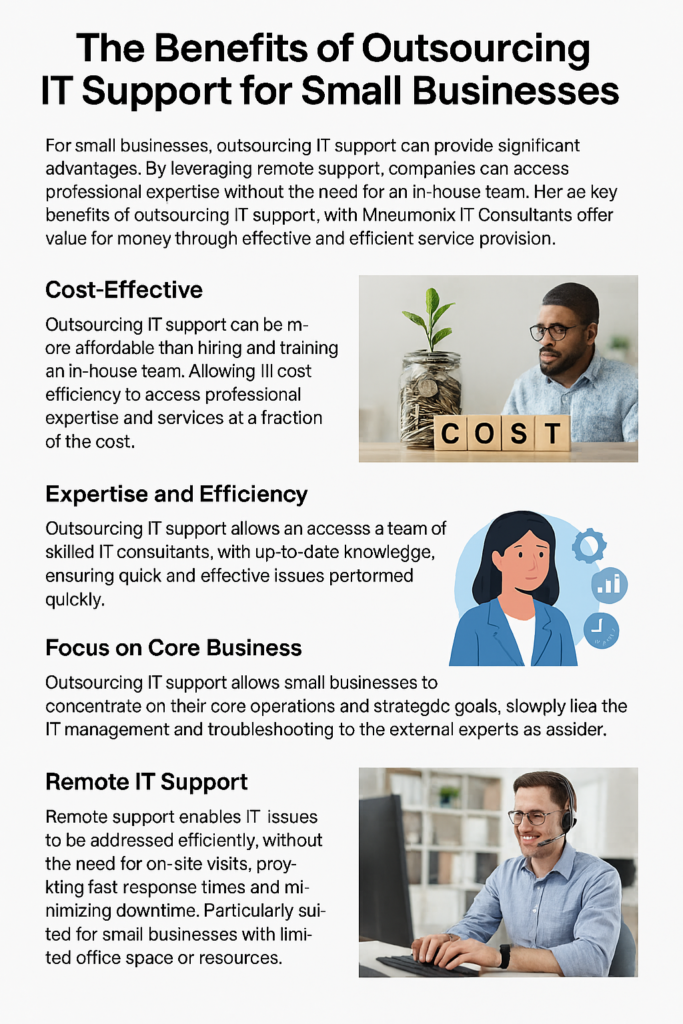
When something goes wrong, every minute counts. Outsourced IT teams specialise in rapid diagnosis and resolution, often spotting issues before they escalate. Remote support accelerates this even further. Instead of waiting for an engineer to travel to your office, technicians can log in securely and fix problems in real time. Mneumonix consultants are trained to resolve issues quickly and effectively, reducing downtime and keeping your business running smoothly.
Freedom to Focus on Core Business Activities

Small business owners wear many hats — but “IT technician” shouldn’t have to be one of them. Outsourcing IT support frees teams from troubleshooting, patching, and system maintenance, allowing them to focus on what truly matters:
- Serving customers
- Growing the business
- Improving products and services
With Mneumonix managing the technical side, businesses can operate with confidence, knowing their systems are in safe hands.
The Power of Remote IT Support

Remote support has become the backbone of modern IT service delivery. Its advantages are especially significant for small businesses:
- Instant response times — no waiting for on‑site visits
- Lower costs — reduced travel and labour expenses
- Minimal disruption — issues resolved quietly in the background
- Scalability — support grows with your business
- Access to specialists — even niche expertise is just a call away
Mneumonix IT Consultants excel in remote service provision, using secure tools and proactive monitoring to keep systems healthy and prevent problems before they occur.
Value for Money Through Effective, Efficient Service
What sets Mneumonix apart is their commitment to delivering high‑quality support without unnecessary complexity or inflated costs. Their approach is built on:
- Clear communication
- Fast response times
- Transparent pricing
- Tailored solutions for small businesses
- A proactive mindset that reduces long‑term IT risks
This combination makes them a trusted partner for organisations that want reliable IT support without the overheads of an internal team.
Outsourcing IT support is no longer a luxury — it’s a strategic advantage for small businesses. With the rise of remote support, companies can access expert help instantly, reduce costs, and stay focused on growth. By partnering with Mneumonix IT Consultants, small businesses gain a dependable, efficient, and cost‑effective IT solution that supports their success today and scales with them into the future.
- What did we learn from the Cloudflare outage, if anything? (11/26/2025)
The Cloudflare outage taught us that the internet’s backbone is fragile, over‑centralized, and highly dependent on single points of failure. It highlighted the need for redundancy, better change management, and diversified infrastructure strategies.
🔑 Key Lessons from the Cloudflare Outage
- Single points of failure are dangerous Cloudflare supports ~20% of global web traffic. When it went down, platforms like X (Twitter), ChatGPT, Spotify, Canva, Shopify, and even government sites were disrupted simultaneously. This shows how much of the internet depends on one provider.
- Root cause: internal misconfiguration, not cyberattack The outage wasn’t caused by hackers but by a faulty database permission update. This change created duplicate entries in a bot management file, which propagated globally and triggered widespread 5xx errors. It’s a reminder that routine updates can have catastrophic ripple effects if not carefully tested.
- Resilience requires diversification Governments and organizations stressed the importance of using multiple cloud providers to mitigate risks. Relying on a single vendor—even one as robust as Cloudflare—can expose businesses and public services to massive downtime.
- Monitoring and transparency matter Outage trackers like Downdetector showed spikes in complaints within minutes. Cloudflare’s CEO quickly acknowledged the issue and published a postmortem. Transparent communication helps maintain trust during crises.
- Centralized infrastructure is fragile The incident reinforced that modern internet architecture is brittle. A single misstep in a centralized system can stall digital life across continents.
🌍 Broader Implications
- Business continuity planning: Companies must prepare for vendor outages with failover systems, cached content, or alternative CDNs.
- Public sector caution: Governments and healthcare systems need multi‑provider strategies to avoid service paralysis.
- Cultural reminder: The outage showed how deeply daily life depends on invisible infrastructure—when it breaks, everything from social media to commerce to public services grinds to a halt.
⚡ Takeaway #1
The Cloudflare outage wasn’t just a technical glitch—it was a wake‑up call. Resilient internet design means decentralization, redundancy, and rigorous change management. Without these, even a routine update can bring the digital world to a standstill.
Businesses learned that resilience requires diversification, redundancy, and proactive risk management. The Cloudflare outage showed that relying on a single provider—even one as robust as Cloudflare—can paralyze operations globally.
🛠 Practical Steps Businesses Can Take
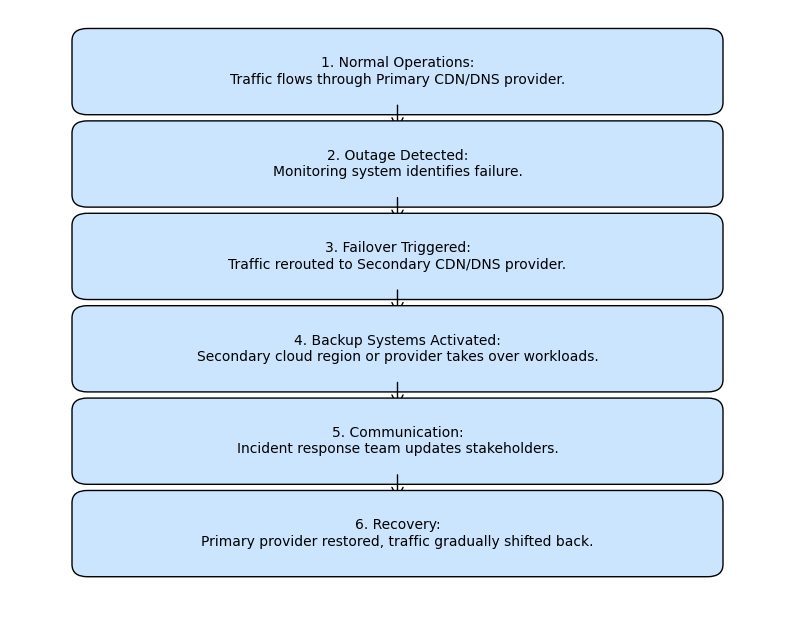
- Adopt a multi‑CDN strategy Don’t let one provider be your single point of failure. Using multiple CDNs ensures traffic can reroute if one collapses.
- Implement failover DNS and backup security layers Secondary DNS providers and layered security systems keep websites accessible even when the primary vendor fails.
- Design for failure, not perfection Outages aren’t rare—they’re inevitable. Systems should be architected with the assumption that things will go wrong, so fallback mechanisms are ready.
- Diversify cloud dependencies Many businesses rely heavily on one cloud or SaaS provider. Spreading workloads across multiple vendors reduces systemic risk.
- Strengthen monitoring and incident response Real‑time monitoring, automated alerts, and clear escalation paths help detect and contain issues faster.
- Test disaster recovery regularly Simulate outages to ensure teams know how to respond. A plan that isn’t tested is just theory.
- Consider digital sovereignty Governments and large enterprises should invest in domestic or independent infrastructure to avoid exposure to foreign provider failures.
🌍 Why This Matters
- SMBs: The outage revealed that small businesses are only as resilient as the weakest link in their tech stack.
- Enterprises: Even with millions invested in security, hyper‑centralization can turn protective systems into vulnerabilities.
- Governments: National economies can be disrupted by foreign infrastructure failures, making sovereignty and local alternatives critical.
⚡ Takeaway #2
The Cloudflare outage wasn’t just a glitch—it was a stress test of global digital dependence. Businesses that build redundancy, diversify providers, and prepare for failure will weather the next disruption far better than those who assume stability is guaranteed.
✅ Business Resilience Checklist (Post‑Cloudflare Outage)
1. Infrastructure Redundancy
- Use multi‑CDN providers to avoid a single point of failure.
- Implement secondary DNS services for automatic failover.
- Ensure critical apps can run in multiple cloud regions/providers.
2. Change Management
- Enforce strict approval workflows for configuration changes.
- Test updates in staging environments before global rollout.
- Maintain rollback procedures for rapid recovery.
3. Monitoring & Alerts
- Deploy real‑time monitoring for traffic, latency, and error rates.
- Set up automated alerts for anomalies.
- Use third‑party outage trackers (e.g., Downdetector) for external validation.
4. Disaster Recovery Planning
- Document failover procedures and rehearse them regularly.
- Run chaos engineering drills (simulate outages to test resilience).
- Keep offline backups of critical data and configs.
5. Vendor Diversification
- Avoid over‑reliance on one SaaS or cloud provider.
- Spread workloads across multiple vendors where possible.
- Evaluate local/regional providers for sovereignty and compliance.
6. Communication Strategy
- Prepare incident response templates for customers and stakeholders.
- Be transparent—share root cause analyses quickly.
- Train staff on crisis communication protocols.
7. Security & Compliance
- Layer security tools (WAF, bot management, DDoS protection) across providers.
- Ensure compliance with industry regulations even during failover.
- Audit vendor contracts for uptime guarantees and SLAs.
⚡ Quick Audit Questions
- Do we have at least two CDNs/DNS providers?
- Can we reroute traffic within minutes of an outage?
- Have we tested disaster recovery in the last 6 months?
- Is our incident communication plan ready and practiced?
This checklist transforms the outage lessons into actionable safeguards. Businesses that adopt these measures will be far less vulnerable when the next big disruption hits.
Remember, you are not alone. Mneumonix can assist you through this process, simply get in touch to find out how we can help.
- The Benefits of Remote IT Management: Empowering Businesses in the Digital Age (10/27/2025)
In today’s fast-paced digital landscape, businesses of all sizes rely heavily on technology to operate efficiently, securely, and competitively. As IT systems grow more complex and distributed, the traditional model of on-site IT support is being replaced by a more agile and cost-effective solution: remote IT management. This approach allows companies to outsource the monitoring, maintenance, and support of their IT infrastructure to specialized providers who operate remotely.
Let’s dive into the key benefits of remote IT management and why it’s becoming a cornerstone of modern business strategy.
💸 1. Cost Efficiency
Remote IT management significantly reduces overhead costs:
- Eliminates the need for a full-time, in-house IT team.
- Offers predictable monthly pricing models.
- Reduces downtime and costly emergency repairs through proactive monitoring.
🕒 2. 24/7 Monitoring and Support
Unlike traditional support limited to business hours, remote IT services offer:
- Round-the-clock system monitoring.
- Immediate response to threats or outages.
- Continuous performance optimization.
🔐 3. Enhanced Cybersecurity
Cyber threats are evolving rapidly, and remote IT management helps businesses stay protected:
- Implements real-time threat detection and response.
- Ensures regular updates and patch management.
- Provides access to cybersecurity experts and best practices.
📈 4. Scalability and Flexibility
As businesses grow or shift operations, remote IT services adapt seamlessly:
- Easily scale up or down based on business needs.
- Support hybrid and remote work environments.
- Integrate new technologies without major disruptions.
🧠 5. Access to Expert Knowledge
Remote IT providers bring a wealth of experience and specialized skills:
- Stay current with the latest tech trends and compliance standards.
- Offer strategic guidance for digital transformation.
- Provide expertise that may be cost-prohibitive to hire in-house.
⚡ 6. Faster Problem Resolution
With remote access tools and automated diagnostics:
- Issues are identified and resolved quickly.
- Reduces downtime and boosts productivity.
- Minimizes the impact of technical disruptions.
🚀 Conclusion
Remote IT management is more than just a convenience—it’s a strategic asset. By outsourcing IT operations to trusted experts, businesses can reduce costs, improve security, and focus on growth. Whether you’re a start-up or an established enterprise, embracing remote IT management can unlock new levels of efficiency and resilience in an increasingly digital world.
If you’re an SME considering making the switch, Mneumonix can help your business streamline its IT support. Contact Us for more information.
- 🔐 Cyber Essentials: Why Every Business Needs This Certification (9/13/2025)
In an era where cyber threats are as common as coffee breaks, businesses can no longer afford to treat cybersecurity as an afterthought. Whether you’re a startup, a mid-sized firm, or a multinational enterprise, obtaining Cyber Essentials certification is one of the smartest moves you can make to protect your operations, reputation, and bottom line.
🛡️ What Is Cyber Essentials?
Cyber Essentials is a UK government-backed certification scheme designed to help organisations defend against the most common cyber threats. It focuses on five key technical controls:
- Firewalls: Prevent unauthorised access to your network.
- Secure configuration: Ensure systems are set up securely.
- User access control: Limit access to data and services.
- Malware protection: Detect and block malicious software.
- Patch management: Keep software up to date to fix vulnerabilities.
These controls form a robust foundation for any organisation’s cybersecurity strategy.
💼 Business Benefits That Go Beyond IT
Cyber Essentials isn’t just about ticking a compliance box—it delivers tangible advantages across multiple dimensions:
✅ 1. Protect Against Common Attacks
The certification significantly reduces your exposure to threats like ransomware, phishing, and data breaches. In fact, businesses with Cyber Essentials are 92% less likely to make a cyber insurance claim than those without it.
✅ 2. Win More Contracts
Many UK government contracts now require Cyber Essentials certification, especially those involving sensitive data. Increasingly, banks and large enterprises are also demanding it from their suppliers.
✅ 3. Boost Customer Trust
Displaying the Cyber Essentials badge signals to clients and partners that you take data protection seriously. In a market where trust is currency, this can be a powerful differentiator.
✅ 4. Lower Insurance Premiums
Some insurers offer discounted premiums to certified businesses, recognising their lower risk profile. For small UK firms, certification may even include free cyber insurance under certain conditions.
✅ 5. Strengthen Compliance
Cyber Essentials helps align your business with regulations like GDPR and the Data Protection Act 2018, ensuring that personal data is handled securely and responsibly.
🧭 A Strategic Move for Long-Term Resilience
Cyber Essentials is more than a technical checklist—it’s a strategic investment in your company’s future. As cyber threats evolve and digital trust becomes a competitive edge, certification offers a clear signal that your business is prepared, proactive, and professional.
If you want further information on how to obtain Cyber Essentials Certification for your business, contact us here at Mneumonix and we’d be happy to assist.
- 🌍 Geopolitics and the Tech Frontier: How Global Tensions Are Shaping Innovation (9/13/2025)
In 2025, technology is no longer just a tool—it’s a battleground. From artificial intelligence to semiconductors, the race for digital supremacy is being shaped as much by diplomacy and national security as by engineering breakthroughs. As geopolitical fault lines deepen, the development and deployment of technology are being redefined by strategic interests, regulatory barriers, and a growing mistrust between global powers.
🔐 Strategic Competition Over AI
Artificial intelligence has emerged as the crown jewel of geopolitical rivalry. The United States and China, in particular, are locked in a high-stakes contest to dominate AI infrastructure, talent, and data ecosystems. This competition has led to:
- Export controls on advanced chips and software: Nations are restricting access to critical AI components to prevent adversaries from gaining technological leverage.
- National AI strategies: Governments are investing heavily in domestic AI capabilities, often with military and surveillance applications in mind.
- Fragmentation of global standards: Competing visions for AI ethics and safety are creating incompatible regulatory regimes, complicating cross-border collaboration.
🧠 Data Sovereignty and the Rise of Digital Borders
Data, once seen as a fluid and borderless resource, is now treated as a strategic asset. Countries are erecting digital walls to protect sensitive information:
- Cross-border data restrictions: The EU, China, and others are enforcing laws that require data to be stored and processed domestically.
- Surveillance fears: Nations worry that foreign data centers could be used for espionage or manipulation, leading to tighter controls on cloud infrastructure.
- Localized tech stacks: Companies are increasingly forced to build region-specific versions of their platforms to comply with divergent data laws.
🏭 Supply Chain Disruption and Tech Fragmentation
Geopolitical tensions are also disrupting the global supply chains that underpin technological development:
- Semiconductor choke points: Taiwan’s dominance in chip manufacturing has become a flashpoint, prompting countries to invest in domestic fabs to reduce dependency.
- Export bans and sanctions: Firms face sudden restrictions on sourcing components or software, forcing costly redesigns and operational pivots.
- Resilience over efficiency: Multinationals are prioritizing IT resilience and geopolitical risk management over traditional cost-saving strategies.
🧭 Corporate Strategy in a Fractured World
For global companies, navigating this landscape requires more than technical prowess—it demands geopolitical foresight:
- Board-level geostrategy: Executives are now expected to anticipate political risks and adapt their tech roadmaps accordingly.
- Regulatory agility: Firms must stay nimble to comply with rapidly shifting laws across jurisdictions.
- Localized innovation: R&D is increasingly decentralized, with regional hubs tailored to local political and regulatory climates.
🌐 The Future: Cooperation or Cold War?
Despite the competitive fervor, there’s a growing recognition that some level of cooperation is essential—especially around AI safety, cybersecurity, and climate tech. The question is whether nations can balance strategic interests with shared global challenges.
As the World Economic Forum notes, “Balancing between collaboration and competition will shape not only who leads in AI, but also how safely and equitably it is integrated into our world”.
- The Ripple Effect: How Donald Trump’s Improvised Speeches Are Shaping the UK IT Industry (7/30/2025)
Donald Trump’s return to the global stage has reignited debates across industries, and the UK’s IT sector is no exception. While his speeches may seem distant from British boardrooms, their improvised and often provocative nature has triggered a cascade of economic and strategic consequences that are being felt across the UK’s tech landscape.
🔊 The Power of Words: Trump’s Rhetoric and Global Perception
Trump’s off-the-cuff remarks—often targeting international trade, immigration, and technology—have created uncertainty in global markets. For UK IT firms, this unpredictability affects:
- Investor Confidence: Volatile statements can shake investor trust, leading to cautious funding rounds and delayed venture capital decisions.
- Cross-border Collaboration: UK firms working with US partners may face increased scrutiny or hesitancy due to political tensions.
- Brand Association Risks: Companies with American affiliations may find themselves navigating reputational challenges in European markets.
📉 Trade Tariffs and Supply Chain Disruption
Trump’s renewed push for protectionist policies, including sweeping tariffs on imports, has direct implications for UK tech companies:
- Hardware Costs: UK firms importing components from the US or China face rising costs due to tariff escalations.
- Export Barriers: British IT products and services may become less competitive in the US market if tariffs are applied indiscriminately.
- Supply Chain Volatility: Increased trade friction forces UK companies to rethink sourcing strategies, potentially shifting to European or domestic suppliers.
🧠 Talent Migration and Immigration Policy
Trump’s stance on immigration—often expressed in blunt, improvised speeches—has inadvertently opened doors for the UK:
- Brain Gain: Stricter US immigration policies may drive global tech talent to the UK, especially in AI, cybersecurity, and software development.
- University Advantage: His criticism of US universities has led to a surge in international students choosing UK institutions, strengthening the future talent pipeline.
⚙️ Innovation vs. Regulation: The AI Dilemma
Trump’s unpredictable approach to AI regulation—sometimes leaning toward deregulation—creates a contrasting environment:
- Regulatory Stability: UK firms may benefit from a more balanced and ethical framework, attracting global partners seeking responsible innovation.
- Competitive Edge: While US firms may accelerate development under looser rules, UK companies can position themselves as leaders in trustworthy tech.
🌍 Strategic Realignment and Opportunity
Despite the turbulence, UK IT firms are adapting:
- Diversifying Markets: Companies are expanding into Asia and Europe to reduce reliance on US partnerships.
- Strengthening Domestic Innovation: Government incentives and public-private collaborations are helping buffer external shocks.
- Rebranding the UK as a Tech Haven: With political uncertainty in the US, the UK is emerging as a stable, attractive hub for global tech investment.
🧭 Final Thoughts
While Donald Trump’s improvised speeches may seem like political theatre, their impact on global economics is tangible. For the UK IT industry, they represent both a challenge and an opportunity—a call to innovate, diversify, and lead with resilience. In a world where words can move markets, the UK’s tech sector is learning to listen carefully and respond strategically.
- Protecting Ourselves in the Digital Age: The Essentials of IT Security (7/7/2025)
In a world where our lives are increasingly entwined with technology, IT security isn’t just a corporate concern—it’s a personal one. Whether you’re streaming from your smart fridge or managing sensitive emails from your laptop, every digital footprint is a potential entry point for cyber threats.
🚨 Why IT Security Matters
The surge in cybercrime—from phishing scams to ransomware attacks—has shown that no one is immune. Individuals, small businesses, and major corporations alike face risks that can result in data theft, financial loss, or identity compromise.
🔐 Core Concepts of IT Security
Understanding the key pillars of IT security helps build strong defenses:
- Confidentiality: Protecting sensitive information from unauthorized access.
- Integrity: Ensuring data remains accurate and unaltered.
- Availability: Keeping systems and data accessible when needed.
🧰 Practical Steps to Stay Safe
Here’s how you can guard your digital realm effectively:
💻 1. Strengthen Your Password Game
- Use complex passwords with a mix of letters, numbers, and symbols.
- Avoid using the same password across multiple platforms.
- Enable multi-factor authentication (MFA) wherever possible.
📧 2. Stay Alert to Phishing
- Don’t click on suspicious email links or attachments.
- Check email addresses carefully—they often mimic legitimate sources.
- If in doubt, contact the sender through a trusted channel.
🖥️ 3. Keep Software Updated
- Install updates promptly for operating systems, apps, and antivirus tools.
- Updates often patch vulnerabilities that attackers exploit.
🌐 4. Use Secure Networks
- Avoid public Wi-Fi for transactions or sensitive tasks.
- Consider using a trusted VPN when accessing data remotely.
🗑️ 5. Back Up Your Data
- Use cloud storage or external drives.
- Regular backups help you recover quickly from attacks or system failures.
🧠 6. Educate Yourself and Others
- Stay informed about new threats and security practices.
- Promote a culture of caution and vigilance in your personal and professional circles.
🔍 Bonus Tips for Businesses
If you’re running a company—even a small one—consider these additions:
- Conduct regular security audits.
- Implement access controls to restrict data exposure.
- Train employees on cybersecurity protocols and incident response.
Protecting yourself online isn’t about paranoia—it’s about preparedness. Taking a proactive stance on IT security empowers you to enjoy the digital world without fear.
- Navigating the Fallout: Understanding the Recent Windows Outage (8/28/2024)
Introduction
In a world increasingly reliant on technology, a recent global IT outage sent shockwaves through businesses, airlines, banks, and hospitals. Let’s delve into the details of this incident, its impact, and the lessons learned.
1. The Outage Unfolds
– The Blue Screen of Death:
– On a fateful day, Microsoft Windows PCs worldwide were hit by what users dread—the infamous “blue screen of death.”
– The culprit? A software update from cybersecurity firm CrowdStrike.– CrowdStrike’s Role:
– CrowdStrike, a major player in cybersecurity, inadvertently triggered the chaos.
– Their Falcon Sensor software update caused Windows hosts to crash, leaving users frustrated and systems paralyzed.2. The Ripple Effect
– Business Disruptions:
– Companies faced operational disruptions. Payment systems went down, flights were delayed, and information screens at airports turned blank.
– Supermarket chains, banks, and airlines all felt the impact.– Global Reach:
– The outage wasn’t confined to a single region. It spread across the globe, affecting millions of Windows devices.
– Microsoft estimates that 8.5 million devices were impacted—less than 1% of all Windows machines worldwide.3. Lessons Learned
– Swift Response Matters:
– CrowdStrike’s CEO acknowledged the issue promptly and deployed a fix.
– However, some systems remained affected, emphasizing the need for rapid response.– Collaboration is Key:
– Microsoft urged affected customers to follow CrowdStrike’s guidance.
– In crisis situations, collaboration between tech giants is essential.– Resilience and Preparedness:
– Businesses must build resilient systems. A single software glitch shouldn’t cause widespread chaos.
– Regular testing and redundancy can mitigate such risks.Conclusion
The recent Windows outage serves as a wake-up call. As technology evolves, so do its vulnerabilities. Let’s learn from this incident, adapt, and emerge stronger.
Remember, even in the digital age, glitches happen—but how we respond defines our resilience.
- AI in the Workplace: Enhancing Efficiency and Productivity (2/7/2024)
In recent years, the rapid rise of AI has transformed the way we work. From automating repetitive tasks to making data-driven decisions, AI is reshaping office environments and revolutionizing the future of work. Let’s delve into how workplace AI can lead to better, safer, and more efficient workspaces.

Understanding Workplace AI
Artificial intelligence encompasses technologies that mimic human interaction and intelligence. These include speech recognition, reasoning, decision-making, and pattern identification. In the workplace, AI systems use algorithms to solve complex problems and automate simple or repetitive tasks. Here are some key areas where AI is making an impact:
- Automation: AI streamlines processes by automating tasks. Whether it’s automated responders, customer service bots, or smart assistants, AI maximizes efficiency by handling routine activities. Data entry, payroll processing, and appointment scheduling are just a few examples.
- Data-Informed Decisions: AI analyzes vast amounts of data to provide insights. Organizations can make better decisions based on data-driven recommendations. From sales forecasting to resource allocation, AI enhances decision-making across the board.
- Predictive Maintenance: AI predicts equipment failures and maintenance needs. By monitoring machinery and infrastructure, organizations can prevent costly breakdowns and ensure smooth operations.
- Greener Offices: AI optimizes energy usage and resource allocation. Smart lighting, heating, and cooling systems adjust based on occupancy, contributing to sustainability efforts.
- Safer Offices: AI enhances security through facial recognition, access control, and surveillance. It helps prevent unauthorized access and ensures a secure work environment.

Benefits of Workplace AI
- Cost Savings: Workplace AI reduces operational costs by automating tasks, minimizing errors, and optimizing resource utilization. Whether it’s streamlining supply chains or managing inventory, AI contributes to the bottom line.
- Data-Informed Decisions: AI provides actionable insights by analyzing data patterns. Organizations can make informed choices, leading to better outcomes.
- Predictive Maintenance: By predicting equipment failures, AI prevents costly downtime and maintenance emergencies.
- Greener Offices: Energy-efficient AI systems contribute to sustainability goals, reducing environmental impact.
- Safer Offices: AI enhances security protocols, safeguarding employees and assets.
In conclusion, workplace AI is no longer a luxury—it’s a competitive necessity. Organizations that embrace AI and deploy it at scale will unlock its full potential, creating more efficient, data-driven, and inclusive work environments.

Remember, while AI brings immense benefits, successful implementation requires understanding, proper deployment, and ongoing learning. As we navigate this AI-powered future, let’s harness its capabilities to build workplaces that thrive.
No feed items found.